By Alessandro Spada – UK & European Affairs Team
Introduction
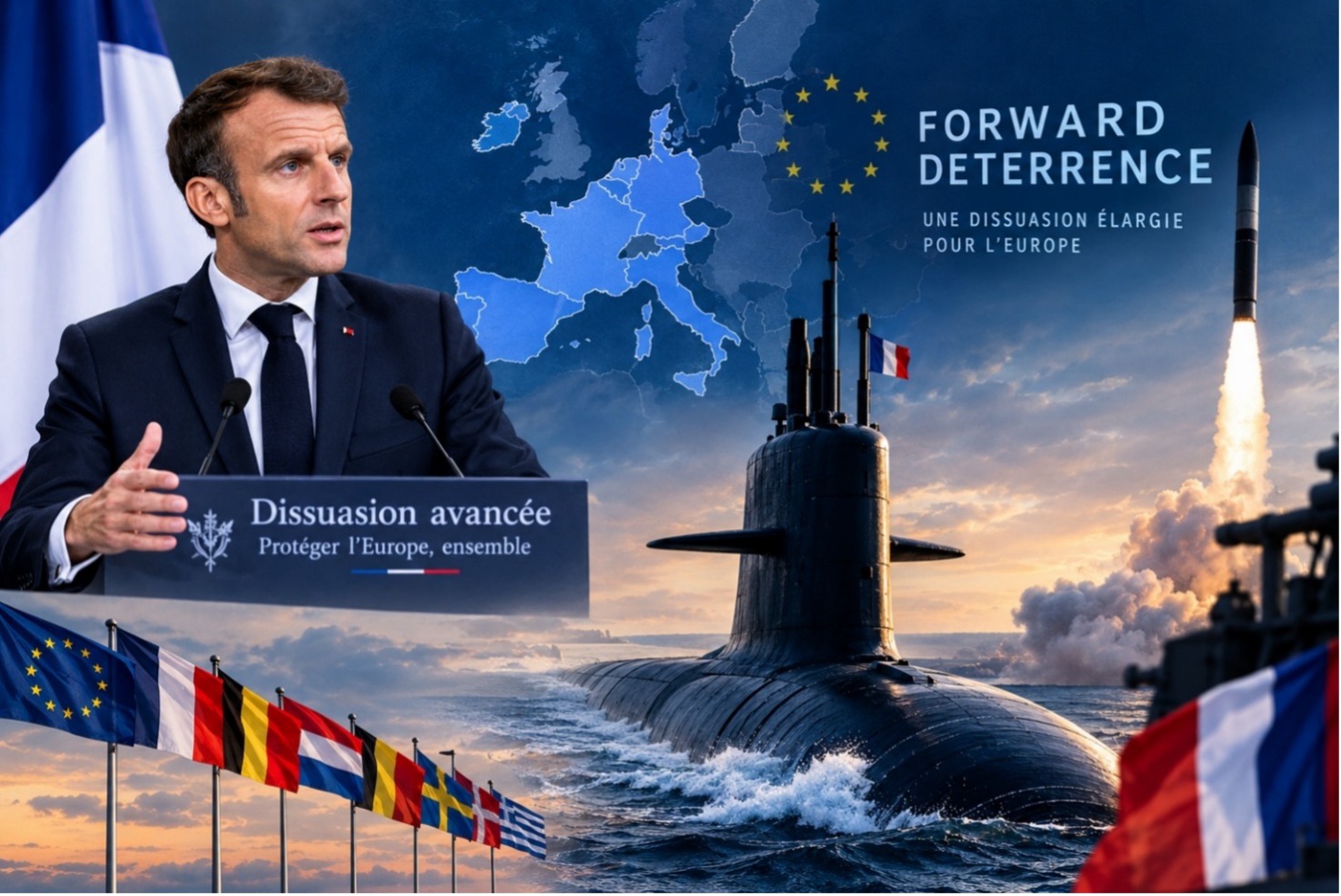
On 2 March 2026, the French President, Emmanuel Macron, delivered a remarkable speech at the heart of the Île Longue base. On this occasion, he announced for the first time the progressive implementation of a new doctrine, known as “forward deterrence”. The purpose is to strengthen French nuclear deterrence against the combination of current threats, defending what France considers “vital interests”. For the first time, the new military strategy would be extended across the European continent, but with full respect for French sovereignty. These days, the geopolitical context is putting at serious risk the endurance of French and European security. President Macron listed the following causes as foundation for the new nuclear deterrence: Beijing and Moscow are increasing and modernising constantly their own nuclear capabilities; the decline of validity of several of nuclear arms-control treaties; last and not least, the ongoing ambiguity of the long-term US role as Europe’s ultimate security guarantor.
What does “dissuasion avancée” mean?
Beyond the UK and Germany, Macron declared that other European countries – Belgium, the Netherlands, Poland, Sweden, Denmark and Greece – decided to join the new "advanced deterrence" strategy. The eight European countries will be able to host France's nuclear bombers stationed in their air bases and also participate in exercises of France's air-launched nuclear capacity – or force de frappe. This atomic strategy would allow France’s partners to also share the development of "auxiliary" capacities: long-range missiles; air defence to shoot down incoming drones and missiles; and space-based alarm systems.
If, on the one hand, there are some advantages for the other European partners, on the other hand, the strategy has some controversial points. First, their current level of around 290 warheads would be increased. Second, from now on, the number of nuclear warheads in its possession will no longer be communicated to the world. Third, the plan will never provide for any explicit “guarantee” to partner countries, and the sole decision-making power over when to launch a nuclear missile will be entitled to only the President of France. Fourth, Macron did state the meaning of vital interests vaguely, although confirming that an attack on a European country could initiate a French response if affecting France’s vital interests.
The French President highlighted that this new cooperation will never replace NATO and the USA’s nuclear deterrent, but will be complementary. However, it would solidify France's strategy of being an independent geopolitical player, possibly moving towards offering itself as an alternative nuclear deterrent for European neighbours in the future.
Characteristics and evolution of the doctrine
Initially, the main purpose of the French nuclear arsenal was to safeguard France's great power status and independence from the USA and NATO. Its primary scope was to defend national territory against attack, while impacting adversaries’ strategic calculations by adding further uncertainty. France’s nuclear doctrine has been based constantly on the principle of entire strategic independence. For this reason, the only NATO member that has never joined the Nuclear Planning Group (NPG) is France. If, on the one hand, the French strategy is intended for the use of nuclear weapons in self-defence and in defence of its vital interests, on the other hand, France’s nuclear capability is oriented toward strengthening both NATO and Europe’s security. Despite the limited scale of its nuclear arsenal compared to that of a potential adversary (first the USSR and subsequently Russia), France does not exclude the option of being the first to resort to nuclear weapons.
However, the use of nuclear weapons went through an evolution of doctrinal principles over time. Whereas during the Cold War the political and deterrent character of nuclear weapons was the dominant principle, intended as a means of immediate and massive retaliation in response to a Soviet attack, after 1989 the possibility of the limited use of nuclear weapons started to become established, in response to threats from a proliferant state or one supporting terrorism. As a substantial consequence, the number of warheads was reduced to the minimum required to guarantee the credibility of deterrence. Additionally, the use of nuclear weapons as battlefield weapons was explicitly ruled out, complying with the basic principle, known as strict sufficiency (stricte suffisance).
During his mandate, President Macron expressed the intent to adapt France’s post-Cold War nuclear doctrine to the current conventional threats, especially from an increasingly aggressive Russia. These changes have been followed by the modernisation of France’s nuclear forces. In accordance with the principles declared by the President’s speech of February 2020, nuclear weapons pursue a strictly defensive nature, and their use is only provided for imminent threats to the state’s vital interests, the definition of which is deliberately kept unclear. A single warning strike can be an envisaged possibility to “restore deterrence”, Macron also said.
Challenges
A further increase in the warhead stockpile could implicate very complex challenges. One of them, a further strengthening of the nuclear arsenal, could bring the public debt out of control and breach the rules of the EU Stability and Growth Pact, exceeding 116% of its GDP in 2025. In the meantime, this could involve cuts in other areas of public spending, raising strong domestic discontent.
Second, Macron's presidency will expire in April 2027, and the current polls continue to project that National Rally, the French far-right party, is ahead. If Marine Le Pen’s party should win the presidential election, this could mean weakening the Europeanisation attempt of nuclear deterrence, as well as the creation of a European common army.
Third, resolving an apparent paradox dominating the heart of this French impetus. If, on the one hand, this initiative aims to reinforce nuclear deterrence, on the other hand, the maximum aspiration remains a world with no nuclear weapons, as expressed by Macron in his speech.
In the end, there is a sequence of tricky questions to answer. How would a French-led nuclear deterrent align with NATO and U.S. nuclear deterrence, considering that France is the only NATO nuclear power outside the Nuclear Planning Group? Given the small size of the French nuclear arsenal, how could Paris and its European allies fill the strategic gap without relying on the American nuclear arsenal in the event of Washington’s disengagement from Europe? What kind of reassurances could Macron guarantee its European allies in terms of implementation, coordination, consultation, functioning, and especially objectives? Indeed, Macron did not clarify the meaning of “vital interests” in case of imminent threats yet, and any decision to employ nuclear weapons will be under the responsibility of France.
Conclusions
According to what has been examined in the previous paragraphs, one might assume some possible scenarios.
The first scenario concerns the next French Presidential elections in 2027. If the National Rally should win the next elections, the new strategy developed by President Macron could have its first setback, and, in the worst case of the hypothesis, the immediate end of the project extended to the other European allies. Although they could be strongly in favour of the warhead number increase, the evident euro-scepticism of the far-right party led by Marine Le Pen could impede the implementation of the new doctrine.
A further increase in nuclear military spending could place additional pressure on France’s public finances, potentially diverting resources from welfare and other public services. This could force the French government to ask the other European allies to contribute to the cost of deterrence.
In conclusion, there could be one plausible solution to overcome most of the main challenges. It could be that Germany, the UK, and the other European allies ask for more transparency and clarification about the meaning of vital interests, threat assessment, consultation mechanisms, doctrine implementation, coordination, and guarantees concerning the steering group's role, composed of Germany, the UK, and France, after bilateral agreements.
No comments.