By Patrick Nicchiarelli - Asia & China Team
The aphorism, related to Sir Walter Raleigh, “Whoever commands the sea commands the trade; whoever commands the trade commands the riches of the world, and consequently the world itself” (Raleigh, 1614), has never seemed truer.
From the Persian Gulf to the Taiwan Strait and the South China Sea, the contest for mastery of the seas is accelerating, and while the classical maritime theories of Alfred Thayer Mahan and, even more so, Julian Corbett remain relevant today, it is being fought with new weapons no navies of the past could have imagined: autonomous submarines, AI-guided drone swarms, and cutting tools designed to sever the underwater cables that carry the world's data. At the centre of this transformation stands the People's Liberation Army Navy.
The theory
Alfred Thayer Mahan: Command of the Sea
In 1890, American naval officer Alfred Thayer Mahan published The Influence of Sea Power upon History (Mahan, 1890). At the core of his theory, the decisive instrument was the battle fleet, a concentrated force with capital ships designed to seek out and destroy the enemy's fleet, seizing command of the sea in a single, culminating engagement.
He identified six key elements determining a nation’s capacity for sea power :
An access to open seas and proximity to major trade routes, the quality of coastline, harbours and navigable rivers, the length of coastline relative to population, sufficient manpower to crew a fleet, a population's aptitude for commerce and seafaring and a political will to invest in and sustain a navy.
The central idea of Mahan’s theory lies in the control of the chokepoint and strategic straits through a powerful battle fleet. The control of strategic straits, where maritime traffic is forced to travel through, confers a disproportionately large advantage relative to the military force required to hold them.
As a result, the United States, Britain, Japan, and Germany all embarked on massive battleship programmes in the 1890s and 1900s, contributing directly to the conditions that produced the First World War. His influence persisted through the carrier-centric doctrine of the Second World War and into the Cold War's nuclear deterrence calculus (Till, 2018). The US Navy's enduring emphasis on aircraft carrier strike groups, concentrated, and designed to dominate the sea, reflects modern-day Mahanian doctrine.
Julian Corbett: Sea Denial and Limited Warfare
For his part, Sir Julian Corbett, a British naval historian, offered a more nuanced counterpoint. Where Mahan saw the sea as an arena for decisive battle, Corbett regarded it as an operational environment to be managed. In his book, Some Principles of Maritime Strategy (Corbett, 1911), he argued that the real objective of naval power was not the annihilation of the enemy fleet, but the control of maritime communications, the sea lanes along which troops, supplies, and goods must pass. The difference lies in the fact that you don't need to control the whole ocean, you only need to deny it to your adversary.
Corbett introduced the concept of sea denial, where a weaker naval power could frustrate a stronger one not by meeting it in open battle, but by making the sea too dangerous to use freely. Mines, submarines, coastal batteries, hit-and-run raids — these were the tools of the weaker party that could impose costs without seeking decisive engagement.
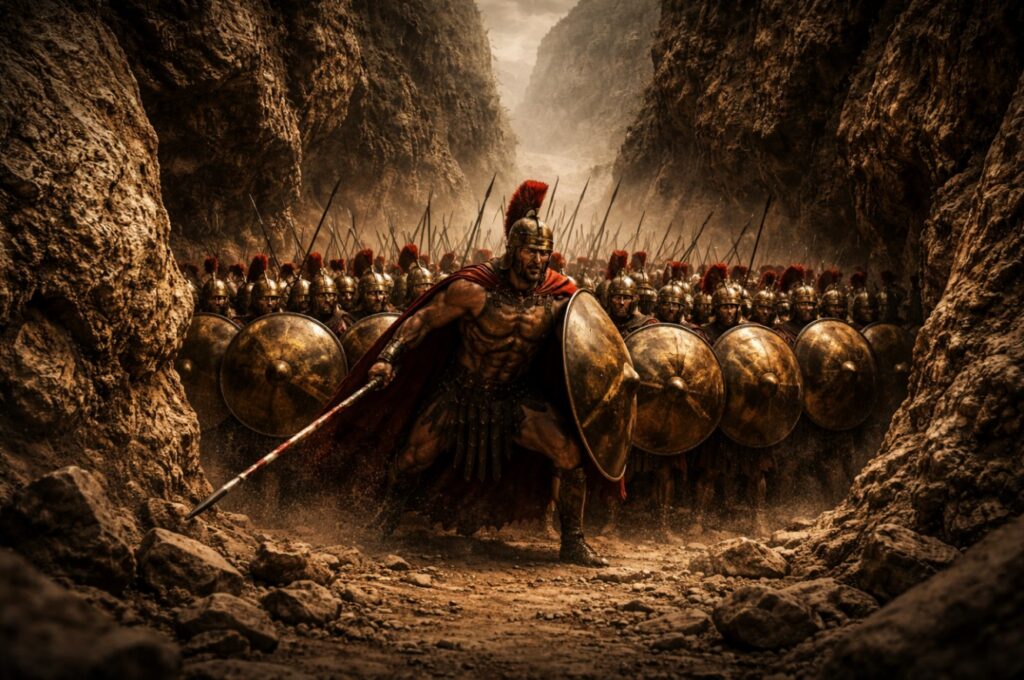
For the landlubber that you may be, let’s make a parallel with the Thermopylae battle, in 480 BC, staged in the film 300 (Snyder 2006) (Pic. 1), where 300 Spartans (and thousand Greek allies) held the narrow pass against the Persian army estimated at several hundred thousand men. They did not seek to defeat Xerxes. They sought to deny him the use of the terrain for as long as possible.
Nowadays, this strategy is called Anti-Access / Area Denial (A2/AD). The defender's objective is to make the cost of using the sea unacceptably high for the opponent.
Applying this theoretical framework to China's maritime strategy, it becomes apparent that its drone programme in particular, follows a distinctly Corbettian logic. Beijing does not seek global Mahanian Sea command yet. Its actual strategy is to deny its adversaries (which at the moment could be considered being the United States and its allies) access to and freedom of navigation within the South China Sea.
Drones, mines, underwater sensor networks, anti-ship missiles, and satellites are the tools of asymmetric warfare. Those devices are sea-denial weapons deployed in a Corbettian framework by China’s People’s Liberation Army Navy (PLAN).
Thus, as PLAN’s capabilities grow, we may wonder whether this posture is a permanent doctrine or a transitional phase on the road to Mahanian ambition possibly related to the String of Pearls, a network of naval facilities and commercial infrastructure stretching from mainland China through the Indian Ocean to the Persian Gulf and East Africa.
The practice: the Strait of Hormuz
Before diving into the heart of the subject, let us take advantage of current events to observe Corbett's theory in real time, with the crisis unfolding in the Strait of Hormuz. Since February 28, 2026, the United States and Israel have been conducting military operations against Iran, and Iran's principal strategic response has been the closure of one of the world's most critical maritime chokepoints, stopping mostly the maritime traffic.
The Strait of Hormuz is, at its narrowest, 33 kilometers wide. Through this corridor flows approximately 25 percent of the world's crude oil and a significant fraction of its liquefied natural gas (EIA, 2025). Every major oil producer on the Arabian Peninsula, Saudi Arabia, the UAE, Kuwait, Iraq, Qatar, are virtually landlocked, related to global markets, without passage through Hormuz (map1).
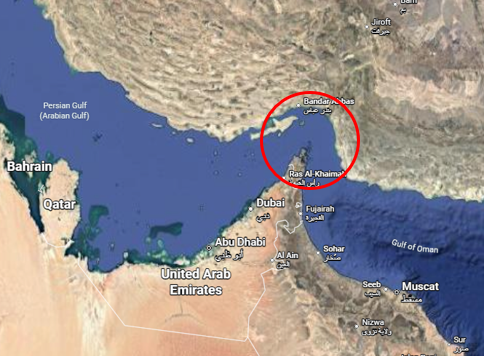
This is Corbett chokepoint doctrine in its starkest form. Iran, with an inferior military navy to that of the US, possesses the capacity to threaten, if not fully execute, such a closure, thereby threatening to restrain one-fifth of global oil supply.
What the current crisis demonstrates is the gap between the threat of closure and its actual execution. At the time of writing, Iran has chosen to implement a selective closure of the strait, allowing passage to allied and neutral vessels while targeting US and their allied flagged ships, effectively operating a discriminatory chokepoint regime (Al‑Mohanadi and Obaid, 2026), then it was to paying vessels.
This partial closure is not a decisive battle, but continuous friction. The cost is immense, war-risk insurance premiums for Hormuz transit have doubled or tripled bringing maritime traffic to an effective standstill, causing oil prices to rise, thus generating mounting pressure on the United States, both from domestic opposition and the international community calling for de-escalation. As a result, Washington was compelled to impose its own counter-blockade to prevent Iran's regional partners from benefiting from the crisis. This is a textbook illustration of Corbett's insight that sea denial, even when conducted by the weaker party, can compel the dominant naval power to expend disproportionate effort simply to preserve the status quo.
Corbett updated: sea denial as economic statecraft
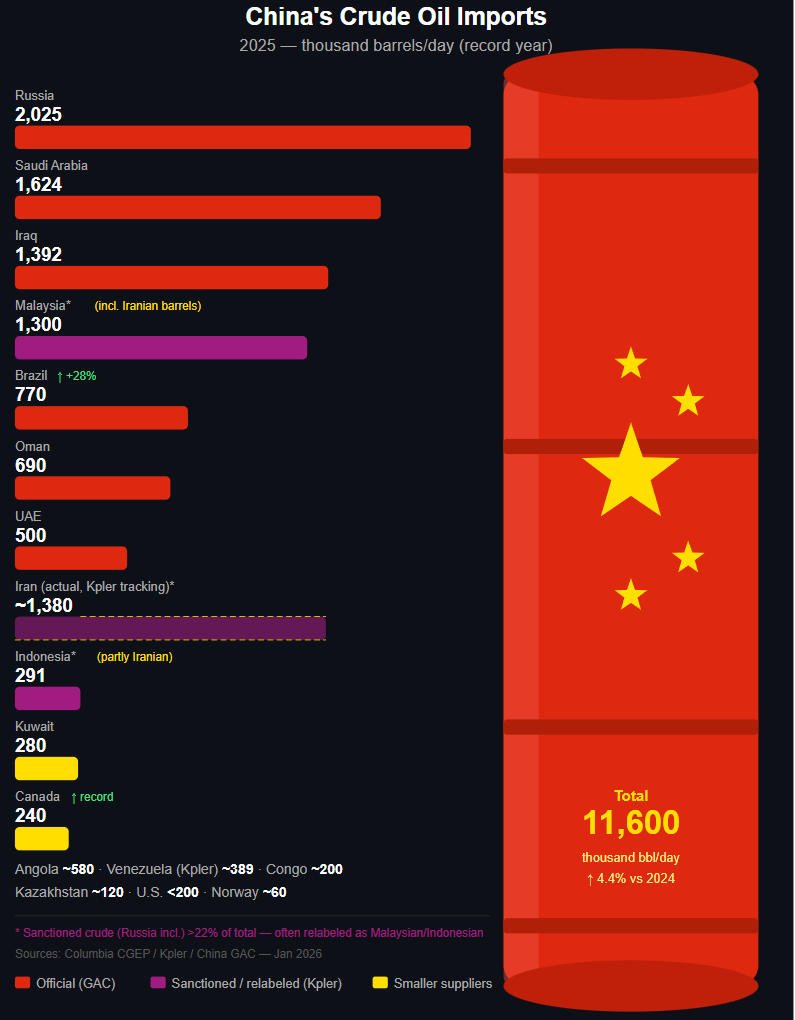
Selective closure deserves particular attention. Indeed, Chinese vessels have in some part been able to continue to pass, until the US started a blockade (Prétat et al., 2026). As a fellow BRICS member, Iran's relationship with Beijing goes beyond simple commercial ties, and there is a message there and from both parts. Let’s not forget that it is also an economic dependency which function as a form of strategic insurance. For Beijing, by remaining Iran's indispensable economic lifeline, absorbing approximately 80 percent of its oil exports, averaging 1.38 million barrels per day in 2025 (Downs, 2026) (table 1), China effectively purchased immunity from chokepoint disruption, ensuring that its energy supply lines were never reduced to zero.
Tehran, in turn, ran a discriminatory chokepoint: closed to its enemies, open to its patron, with at least two paying transit fees denominated in yuan, brokered by a Chinese maritime services company acting as intermediary (Lloyd’s List 2026).
Iran's Foreign Minister confirmed that the strait remained open to countries that neither participated in nor supported acts of aggression against Iran (Al Jazeera, 2026). This is a preview of how great-power competition over maritime chokepoints will be fought in the coming decades, not only with armament, but with energy contracts and economic architecture.
Indeed, there is something very important here, what it reveals goes well beyond a simple passage fee. The strait is being used as a tool to boost the Chinese yuan as an alternative to the US dollar in global energy transactions, which is a long-standing strategic objective for Beijing. The Hormuz crisis offered a test case for yuan-denominated energy payments at scale, as China already did with the iron ore trade settlement (IDNFinancials, 2025). So, while Western financial infrastructure is being weaponised against Iran, China demonstrated that a parallel payment channel exists for those unwilling to remain hostage to dollar hegemony.
On the other part, allowing allied and neutral vessels to continue trading with minimal disruption, Iran simultaneously preserves its economic relationships, creates new diplomatic relation or commercial channels, and erodes the usual western « cohesion » forcing US allies into publicly questioning Washington’s operations. To counter that strategy, its opponent had no choice but to enforce the blockade to ensure that neither Iran’s allies nor countries with agreements could pass through, at the risk of alienating everyone, its own allied included.
Those are consequences to the chokepoint politics that Corbett's original framework did not account for, and that the Hormuz crisis has brought into sharp focus. When a weaker power successfully weaponises a strait, it does not merely inconvenience the dominant naval force, it simultaneously signals to every third-party nation in the international system that alignment with the chokepoint holder carries tangible economic value. Countries with no ideological affinity for Tehran such as India and France, quietly negotiated passage arrangements, prioritising the continuity of their trade flows over solidarity with the Western coalition (Euronews, 2026).
Taken together, these dynamics point to something more consequential than the tactical outcome of the strait closure. By resisting the US attack and imposing its own terms on maritime traffic, Iran effectively established itself as a regional hegemon. The message to surrounding states was unambiguous: no transit through the Strait of Hormuz, nor through the Bab el-Mandeb (controlled via the Houthi proxy in Yemen), occurs without Tehran's consent.
In sum, a regime operating under degraded, sanctioned military capacity and sustained bombardment nonetheless succeeded in restricting maritime traffic through one of the world's most strategically vital chokepoints.Now imagine the same doctrine with a nation possessing a huge industrial capacity, with autonomous submarines, AI-guided drone swarms, the world's largest coast guard, and a militarised fishing fleet permanently deployed. This nation is the People's Republic of China.
The South China Sea
The South China Sea: Where History, Commerce, and Strategy Converge
To comprehend China's naval strategy in 2026, one must first understand how the era, known as the Century of Humiliation, happened at a time China had no navy worth the name. The consequences still resonate today as this memory has been institutionalized and is still used as a motivating tool in China’s posture toward the West (Nicchiarelli, 2023).
Indeed, during the Opium Wars (1839–1842 and 1856–1860), China was unable to oppose the foreign navies sent to force the Qing government to accept the Treaty of Nanking in 1842 and the Convention of Peking (1860). The enemy fleets navigated the same routes that today’s oil tankers and container ships follow: the Strait of Malacca and the South China Sea, offering access to China’s coastline (map 2).
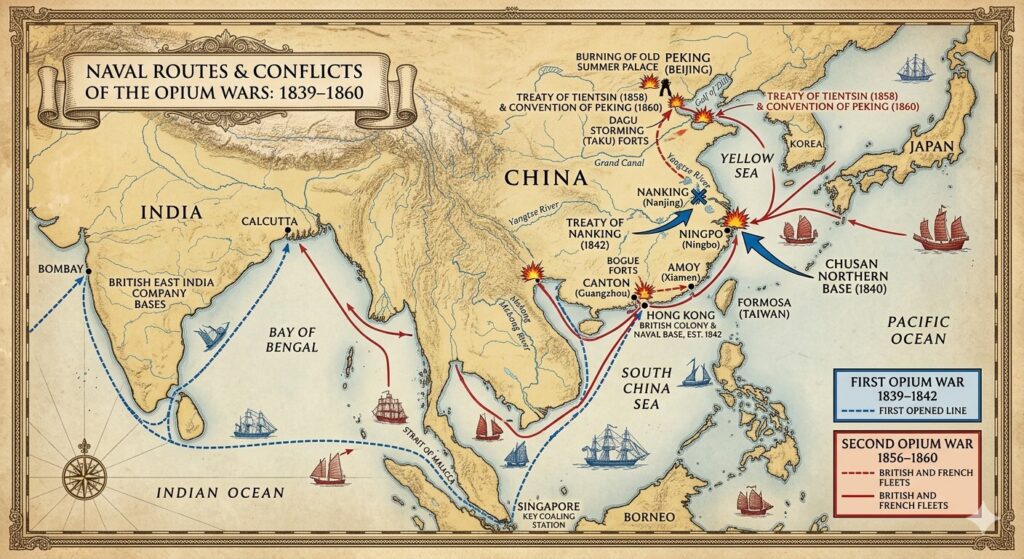
Western navies did not attack China via land, they used the sea China’s navy was too weak to defend. Today, Xi Jinping’s Chinese Dream rests, in part, on a naval ambition: to ensure that no foreign fleet can ever again impose its will on China from its own waters (Eudeline, 2023).
The South China Sea today: the nine-dash line and the artificial islands
This is precisely why China invokes the nine-dash line, asserting historical rights over nearly 90% of the South China Sea, bypassing the distance-based framework established by UNCLOS) (pic 2), and encroaching on neighboring countries maritime’ borders (map 3).
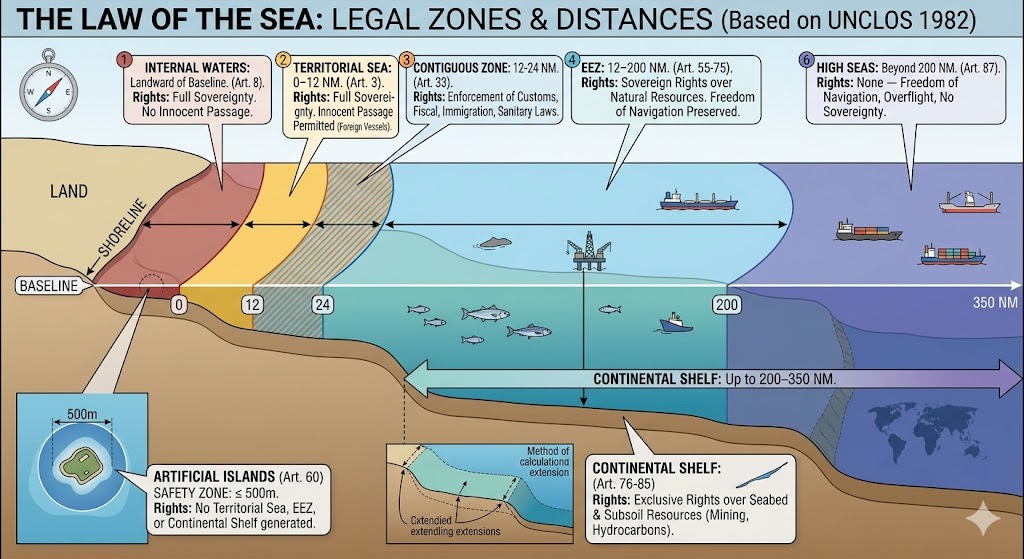
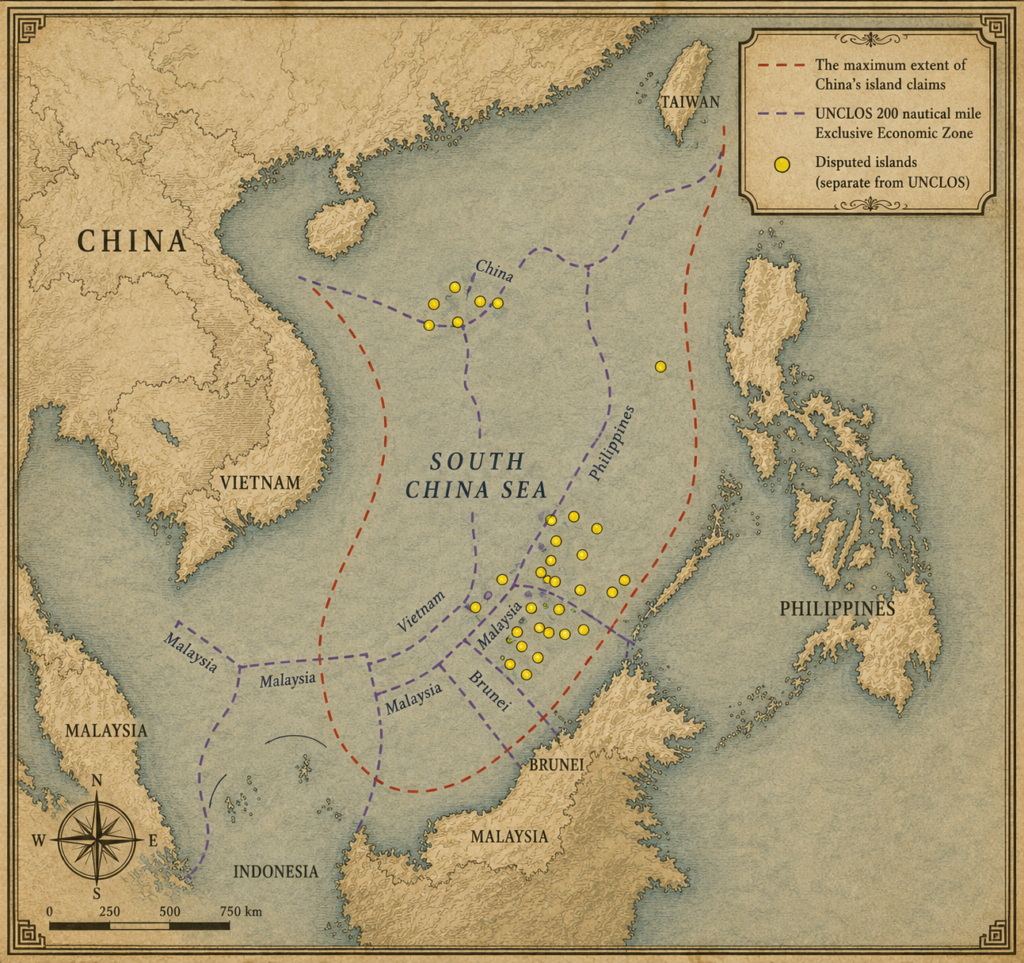
The securitisation of the nine-dash line area serves several purposes. While there is an economic dimension to this situation which encompasses hydrocarbon extraction, fisheries control, seabed mineral rights, dominance over global shipping lanes, and the protection of China's Belt and Road maritime infrastructure, I will focus on the security part.
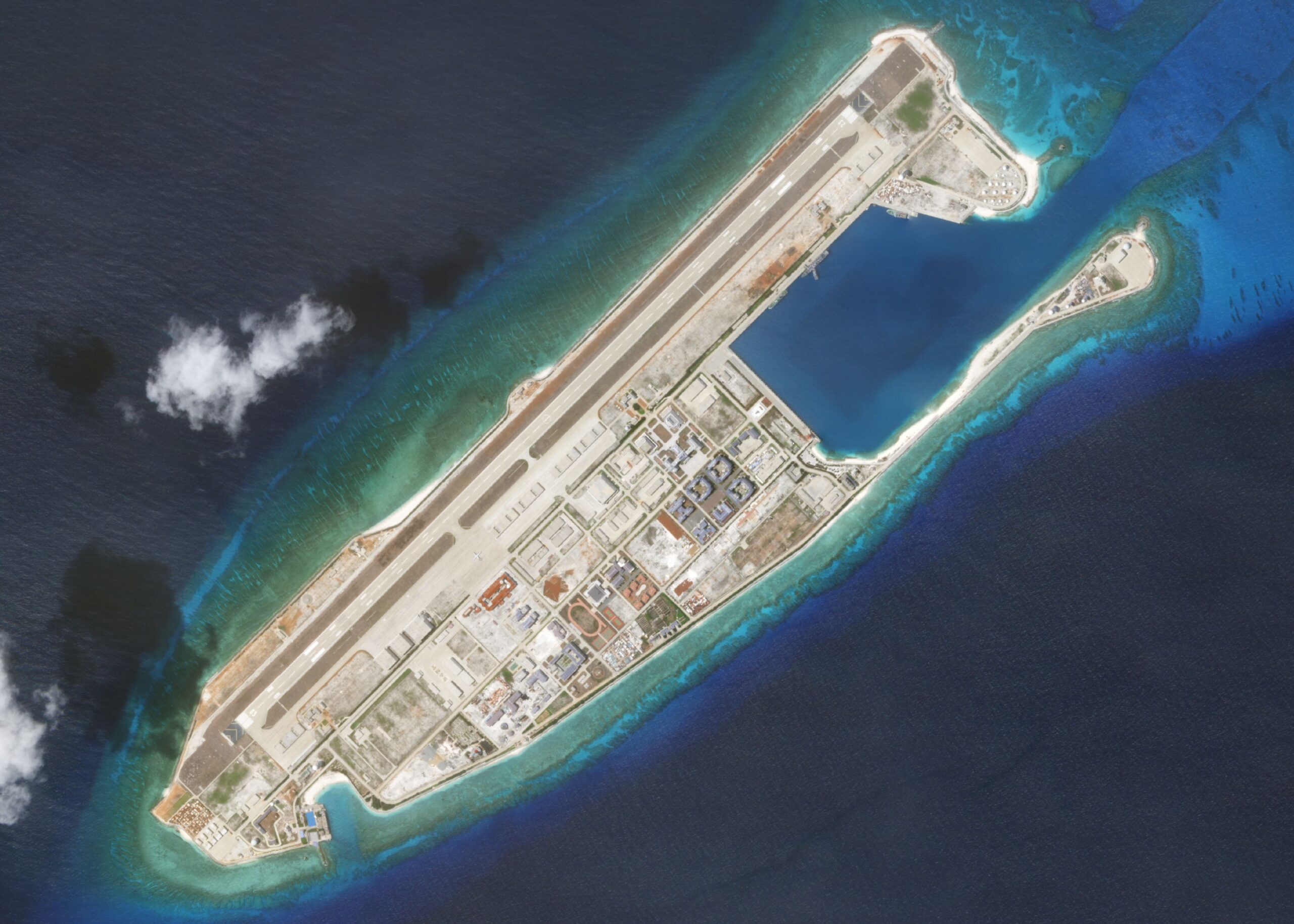
To appreciate China's A2/AD strategy in the South China Sea, we must highlight what can be seen as one of the most impressive engineering projects in modern military history. The dredging and building of artificial islands across the disputed Spratly archipelago, transforming submerged reefs into fortified military bases enabling power projection across the entire southern half of the South China Sea.
Nevertheless, Beijing is not the only actor engaged in establishing outposts. In total, seven parties hold overlapping territorial and maritime claims across the area: the People's Republic of China, Taiwan, Vietnam, the Philippines, Malaysia, Brunei, and Indonesia. Indeed, while together, the Chinese fortified islands, Fiery Cross Reef, Mischief Reef, and Subi Reef create an area covering approximately over 1,200 hectares of new land (Newsweek, 2025), Vietnam alone had created more than 931 hectares of artificial land, expanding all 21 of its occupied territories. However what sets China's construction apart, is the military grade building: full-length military airstrips, radar arrays, hardened missile batteries, and deep-water naval berths capable of hosting the PLA Navy's largest ships, forming the core foundation on which China’s A2/AD architecture in the South China Sea will rest.
China's Maritime Forces
As outlined, two complementary or competing theories frame our analysis: Mahan's emphasis on decisive naval power and sea control, and Corbett's focus on sea denial. China's approach to control in the South China Sea may be conceptualised in three stages. The first is illustrated by the People's Armed Forces Maritime Militia (PAFMM), which operate in the grey zone between peacetime, and helps sustain the narrative of Chinese fishermen having operated these waters for centuries while simultaneously serving as an instrument of Beijing's surveillance. The second involves the Coast Guard, deployed as a police force signaling a de facto Chinese sovereignty (since police service can, by definition, only operate within national jurisdiction). Both are related to the civilian world and peace time. The third is the PLAN, serving a dual function: providing a deterrent shield for Coast Guard operations, and forming the outer layer of the A2/AD architecture (Nicchiarelli, 2023), on which we will focus.
The People’s Liberation Army Navy
The PLAN has undergone the most rapid naval expansion in peacetime history. Nevertheless, while China's navy is by far the largest of any country (table 2), surpassing the US Navy in sheer numbers of ships, in terms of tonnage the US Navy is still the number one (table 3).
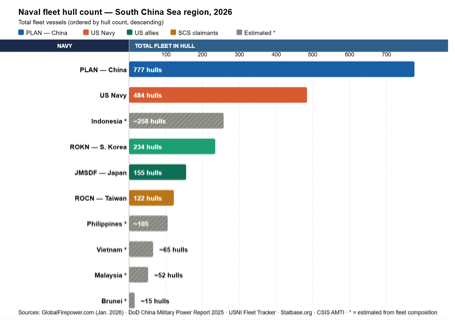
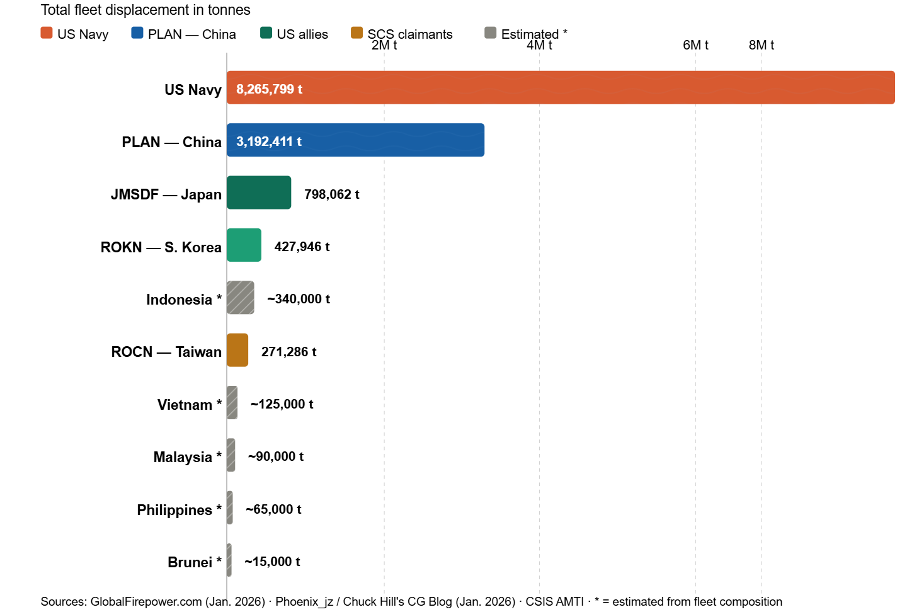
What these figures reveal are two distinct naval strategies. The US Navy has fewer and older hulls, but considerably larger and heavier, and a fleet architecture deeply rooted in Mahanian doctrine, built to be able to sustain its presence across multiple oceanic theatres simultaneously, in theory. China's navy, by contrast, is more numerous and markedly newer, a direct consequence of the PLAN's relatively recent and still-ongoing transformation from a coastal defense force into a blue-water navy as shown in tables 2 and 3. As it stands, the fleet is designed primarily for regional sea denial and luring to a power projection within the First and Second Island Chains, and later on, for the protection of China's extended maritime interests along the String of Pearls stretching from the South China Sea through the Indian Ocean to the Persian Gulf.
China’s Industrial Advantage
However, these figures also reveal a deeper concern about the US ability to sustain an active combat presence across multiple theaters. The defense industry does not currently appear able to build ships and produce the weapons systems needed to arm them fast enough to absorb the cost of several simultaneous battlefields. Indeed, the ongoing war against Iran has provided a clear illustration of this industrial and logistical challenge. To sustain Epic Fury, the Pentagon has diverted munitions to the Middle East from bases in Asia and Europe. This situation created a sense of frustration from regional allies whose stockpiles were drawn down, leaving them less able to sustain military operations if required. And it also raised concern about the US ability to maintain its defense commitments and the capacity of its defense industry to meet operational and contractual demands simultaneously (Dennis and Gettinger, 2026). Nevertheless, it is worth noting that recently, the U.S. Air Force developed the Rusty Dagger cruise missile (AGM-188A) in record time. AEDC built and tested a scale model in under three days, delivering results in 67 hours. The overall program went from contract to live-fire testing in under 16 months, versus the decade such efforts normally take. This shows that full U.S. commitment can produce rapid, unexpected breakthroughs.
Concerning naval assets, according to the US Office of Naval Intelligence (ONI), Chinese shipyards possess the capacity to produce approximately 23,250,000 tons, compared with less than 100,000 tons for the United States (The War Zone) per year. To highlight this situation, in 2024, the Shanghai-based China State Shipbuilding Corporation (CSSC), built more commercial vessels by tonnage than the entire US shipbuilding industry has produced since World War II.
Interestingly, while the Western narrative regarding the gap in shipbuilding between China and the US is portrayed as alarming, from a Chinese perspective it is the opposite. This gap represents a catch-up, thus, the military-civilian integration ensuring that Beijing will not need to rely again on foreign powers for its defense. It should be noted that the Trump administration has also asked civilian companies to contribute to the manufacturing of military equipment (Fox Business, 2026), to ramp up the production of military equipment.
But the conflicts in Ukraine and, more recently, the Persian Gulf have brought a new reality into sharp focus. The growing prevalence of asymmetric warfare with the large use of unmanned aerial systems (UAS), changing the balance of forces and the way combat is fought. Thus, what about a similar production capacity but for the drones, and more specifically to less visible but equally consequential systems, unmanned surface and underwater vehicles (USV & UUV), which may also quietly rewrite the rules of naval warfare.
The Shift Toward Maritime Drones
Since the 1950s, starting with the Sound Surveillance System (SOSUS) a network of acoustic sensors designed to detect Soviet submarines, Washington has progressively expanded its monitoring capabilities around China's surrounding seas with fixed and mobile seabed sensors, surface surveillance vessels, anti-submarine aircraft, maritime drones and low-Earth-orbit reconnaissance satellites, creating an intelligence network aimed at tracking Chinese naval activities (Martinson, 2025).
But Beijing only really started to improve the PLAN capabilities after the 1995-1996 Taiwan Strait Crisis, when China conducted missile tests and military exercises near Taiwan due to the Taiwan's president, Lee Teng-hui visit to the United States. In response the US deployed two carrier battle groups, centered on the aircraft carriers USS Nimitz (CVN-68) and USS Independence (CV-62), near Taiwan. The conclusion for China was that it could not prevent U.S. naval forces from entering what it considers its area, due to its weak coastal navy and lack of surveillance systems to monitor the region. Thus the idea to make an U.S. intervention near China prohibitively costly (Ding, 2003), if the PLAN could not match the US NAVY.
The first improvement was done by purchasing Russian military assets. In the 2000s China started to develop its own military industry which led in the 2010s to the emergence of a blue-water navy. At the same time, in 2014 Professor Wu Lixin launched the “Transparent Ocean” Program. It implied a four-layer network composed by satellites, USVs, UUVs and a seabed sensor network and was presented as a civilian project aiming to make the marine environment observable in near real time from the surface down to the deep sea.
While the presented goals were to improve ocean forecasting, climatology, and study of marine resources, its military advantage is undeniable as it allows to generate highly detailed data on temperature, salinity, currents, acoustic properties, and seabed topography, critical information in undersea warfare. Even more valuable when the data coverage extends from the South China Sea, to the western Pacific, near Guam, the east of the Philippines, some parts of the Indian Ocean, around the approaches to the Strait of Malacca, and more recently into selected Arctic areas (McKenzie, 2026). So, in many aspects, the Transparent Ocean program can be regarded as the twenty-first century equivalent of the U.S. SOSUS network, combining undersea surveillance with modern digital technologies. In clear, Beijing is again trying to equalise the situation with the US.
The backbone of this “Submarine Great Wall” consists of 64 oceanographic research vessels, and its centerpiece is the Zhu Hai Yun, a dedicated mothership that can deploy and control more than 50 unmanned platforms, including aerial drones, autonomous surface vessels, and underwater gliders (Smith, 2026). The development of Chinese Unmanned Surface Vehicles (USVs) and Unmanned Underwater Vehicles (UUVs) can be considered as a response to the extensive U.S. maritime surveillance architecture in the region, therefore the modern embodiment of Corbett’s Sea Denial theory. They are low cost compared with missiles, submarines and ships, and operating in swarms they are capable of saturating a maritime area such as a strait or a littoral without risking the life of military personnel. And, by the way, underwater they are difficult to detect. Reason why maritime drones appear in different sizes and with diverse capabilities, from small ones to submarine size (Pic 6).
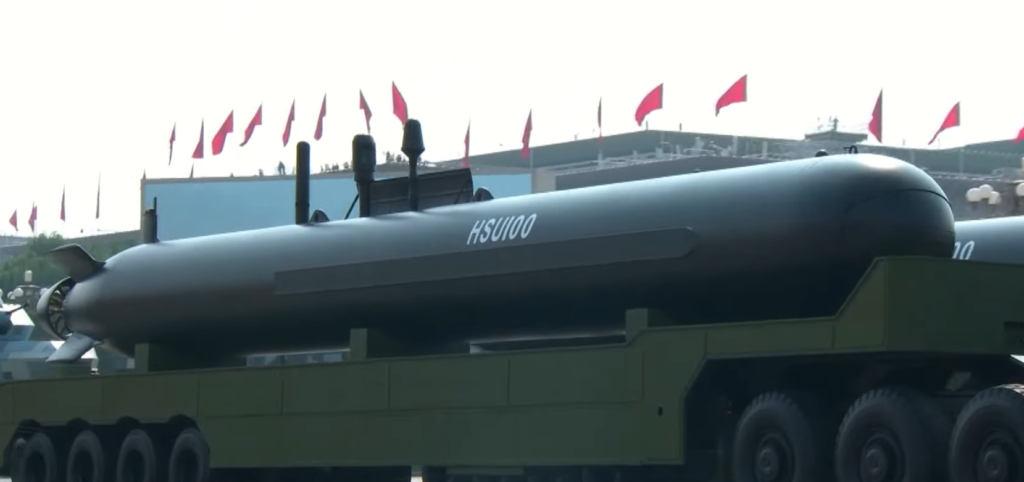
One tactic commonly linked to drone warfare is the swarm attack. The main idea rests on an inversion of the cost of maritime defence. By saturating the defender's defences with cheap mass-produced platforms, the attacker imposes a structurally losing exchange. High-value interceptors expended against low-value targets, until the ammunition is depleted, forcing withdrawal or de-escalation. The asymmetry is economic and logistical, and it operates regardless of whether the engagement is won. This scheme theorised as the «interceptor trap» by Rudraksh Pathak, was illustrated with Iran at the regional scale. The South China Sea could see the same logic being reproduced, and prove, once again, that generals are always fighting the last war, as the US is also investing in USV swarms, by deploying thousands of them in the Indo-Pacific Asia Times.
Quantitative comparison between China and the United States
At first glance, the balance of naval drone power seems to favor the U.S., though only marginally. In 2023, the US Navy and Coast Guard deployed more than 80 USVs for surveillance and reconnaissance missions, while China deployed over 150 for coastal and riverine surveillance (Future Market Insights). These figures should be read with caution, however, as they make no distinction between combat platforms, ISR assets and scientific research vessels.
The picture becomes clearer when we look at what each side has announced for the years ahead. On paper, the advantage shifts decisively toward Washington. During the Sea-Air-Space Symposium in 2026, Captain Garrett Miller, commander of Surface Development Group One, projected more than 30 medium unmanned surface vessels and thousands of small USVs in the Indo-Pacific by 2030, based on requirements looking out to 2045 (USNI News, 2026). The May 2026 shipbuilding plan backs this up with concrete numbers: 47 MUSVs are planned, alongside the Orca XLUUV program, funded at $135.8 million in FY2027 for two vehicles and roughly $1.13 billion across the Future Years Defense Program for a total of 16 vehicles by FY2031 (The Defense News, 2026). No equivalent Chinese program has been disclosed at this level of detail,
Yet, the question is who can actually build at scale? Morgan Stanley estimated in November 2025 that China's drone production capacity is a significant multiple of America's, a gap that prompted Army Secretary Daniel Driscoll to announce plans to purchase at least one million drones within two to three years, up from roughly 50,000 units today (Investing.com ). It appears that China can produce an estimated 500,000 drones per month, compared with 8,000 to 10,000 for Taiwan and a Ukrainian target of 4 million per year (Global Taiwan Institute, 2025). China also counts more than 90 component manufacturers, controls around 80 percent of the global supply chain and holds over 70 percent of the world market. Even in the USV segment, where Turkey currently leads and the United States is set to nearly triple its investment from $176 million to $469.3 million by 2034 (Campbell, 2024), industrial depth remains the decisive variable. In short, Washington holds the technological race, but Beijing holds the industrial one.
The escape routes: China's merchant marine under blockade
Before concluding, let us reverse the perspective. This article has examined China as the architect of sea denial; but what happens when the People's Republic finds itself on the receiving end, with the Taiwan Strait and the South China Sea closed to its merchant fleet, as the Trump administration did in response to Iran's closure of the strait. History, for once, offers a direct answer, because China has already lived through exactly this scenario, and for thirty years.
Indeed, from 1949 to 1979, the Republic of China (ROC) enforced the Guanbi ('closure') policy, a de facto naval blockade of Communist-held ports designed to disrupt trade and logistics to the newly established PRC. ROC naval forces patrolled and intercepted ships in the Taiwan Strait and adjacent waters, stopping or detaining numerous foreign merchant vessels, including British, Polish and Soviet ships, (Guanbi policy). The blockade was only formally lifted on 12 September 1979, in the wake of the US-PRC normalization. For three decades, therefore, traffic bound for the mainland had to sail around Taiwan. While not often remembered, it adds one more layer alongside the Century of Humiliation discussed in section III, in the institutional memory that drives today's naval build-up.
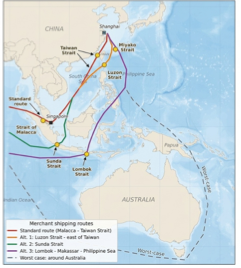
Nevertheless, the stakes of a modern closure of the Taiwan strait are of a different magnitude. Nearly 1.4 trillion dollars of Chinese trade transits through it each year; in 2024, about 33 percent of China's imports and 16 percent of its exports passed through it, against 21 and 14 percent respectively for the Strait of Malacca (CSIS ChinaPower). The CSIS concludes that Beijing faces less a 'Malacca dilemma' than a 'Taiwan Strait dilemma': a conflict that closes the strait would hurt China's economy even more than a disruption of Malacca (Prétat et al., 2026). So what are the options for the Chinese merchant marine? Three escape routes exist, and each of them, as we shall see, reproduces the very problem it is supposed to solve (map 4).
The first is the eastern detour. If the strait is impassable, vessels can route through the Luzon Strait and sail east of Taiwan. This is not theoretical: during the August 2022 exercises that followed Nancy Pelosi's visit, traffic in the strait collapsed from roughly 250 ships a day to 15-20, and shipping was rerouted around the eastern side of the island at the cost of about three days' delay (TIME, 2022). But the detour has two weaknesses: the route east of Taiwan is exposed to cyclones (Uren, 2022), and above all, ships forced through the Luzon or Miyako straits become vulnerable to a distant blockade by US and Japanese forces, the very scenario that has haunted Chinese planners since Hu Jintao's 'Malacca dilemma' speech of 2003.
The second is the Indonesian archipelago. Should Malacca itself be closed, tankers can reroute through the Sunda Strait, whose shallow draft excludes the largest vessels, then through the Lombok and Makassar straits, and, in the worst case, around Australia and up the eastern side of the Philippines, adding days or weeks of sailing and billions in extra costs (CSIS, 2026). Shifting cargo overland is hardly better: moving goods by road from Guangzhou to Tianjin costs about three times the sea freight. Every southern alternative, in short, remains within reach of the US Navy.
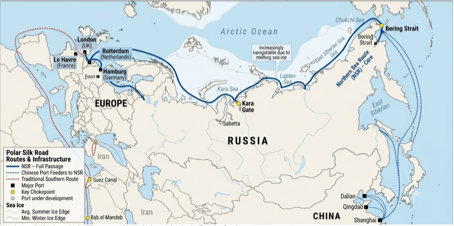
The third escape route runs over the Artic Ocean (map 5). Under the banner of the 'Polar Silk Road', the Arctic extension of the Belt and Road Initiative, Beijing has been turning the Northern Sea Route (NSR) along Russia's Arctic coast into a usable, if seasonal, component of its logistics. A Dalian-Rotterdam voyage takes around 33 days via the NSR against 48 via Suez (The Diplomat, 2023), and it bypasses every single chokepoint the US Navy could hold, from Malacca to Bab el-Mandeb. In late 2025 the container ship Istanbul Bridge inaugurated the first 'China-Europe Arctic Express' liner service (CNN, 2025), and the 2025 season saw 103 transit voyages along the corridor, up from 97 in 2024 (Corporate Knights, 2026).
Yet the Arctic option comes with its own toll booth. The NSR is seasonal, dangerous and thinly covered by search-and-rescue; more importantly, it is administered by Russia through a permit regime, with mandatory pilotage and icebreaker escort, the fees being collected by a subsidiary of Rosatom (Corporate Knights, 2026). Plus, the route is a legal and financial chokepoint as much as a physical one: after 2022, COSCO all but suspended its NSR operations for fear of secondary sanctions linked to the war in Ukraine (The Arctic Institute, 2026). In other words, by going north China does not escape the chokepoint problem, it merely exchanges a vulnerability to the US Navy for a dependency on Moscow (Eurasia Review, 2026).
Conclusion
It appears that the nation building the world's most sophisticated sea-denial arsenal is also the one whose trade is most exposed to the sea denial of others. Its three escape routes lead, respectively, into a US-Japanese surveillance net, back into the US Navy's operating area, and under a Russian toll booth. Seen from Beijing, the conclusion writes itself: if the chokepoints cannot be escaped, they must be mastered. Hence the artificial islands, the Transparent Ocean, the drone swarms and the 23 million tons of annual shipbuilding capacity, wall of which point to the same strategic imperative. Raleigh's aphorism has simply been updated: whoever controls the chokepoints controls the trade, and whoever controls the trade, in the end, controls the world.