November 30, 2021 — No Comments

Drought in Iran: What to expect?

By: Shahin Modarres, Yasmina Dionisi and Filippo Cimento.
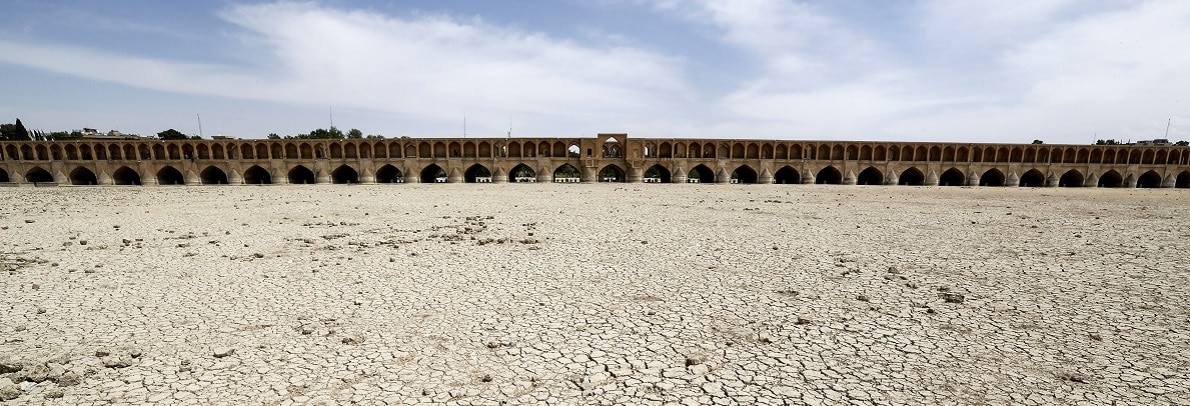
Image Source: https://www.resetdoc.org/story/drought-worse-sanctions/

May God protect this land from foe, drought, and falsehood. This famous prayer engraved in the heart of Apadana Palace in Persepolis by the Persian Shahanshah Darius the Great has a particular meaning to Iranians, but why? Where do we stand 2570 years after these words were said?

A nation without water is a nation without the most crucial flow of life. Water is undeniably recognized as a priority for human sustainable development and linked to all other environmental and societal concerns.

It should come as no surprise then that the importance of water, and its role as a vital commodity, considerably increase in arid and desert areas. These, specifically, are regions where the natural phenomenon of drought does not only frequently occur but bears rather alarming economic, social and environmental costs. 

Iran is no stranger to an arid climate. Located 20 to 45 degrees north, more than 90 percent of the country’s area is dry. The question of water drought is relevant in such a country whose society and economy can be said to be water-dependent: water has played a key role in its society since the establishment of the first known human empire in the southwestern part of Iran.  Drought should be addressed as an urgent concern. Three major consequences of water drought in Iran are delved into in this article: respectively on the agricultural sector, on energy production in regards to hydroelectricity, and ultimately on internal migration.

Agriculture

Drought primarily affects the agriculture sector. Studies on the Iranian agricultural sector are limited but its major role in Iran’s political economy and food security can still be denoted. The country aims towards becoming fully self-sufficient in food production and food security remains a priority in Iran. 

Arid areas like the Middle East rely on irrigation. Reportedly, in what is the water used for agriculture, irrigation accounts for about 20% of the global agricultural evapotranspiration.   What has been evident is that Iran's agriculture is heavily impacted by water availability. Dating back to July 1968 when the Nationalization of Water Resources act was enacted, and all water in the country was considered a natural wealth and belonging to the nation; the relation between Iran’s agricultural sector and water use hardly goes unnoticed: Iran’s agricultural sector is, as a matter of fact, responsible for about 90% of water consumption at a national scale. From 2005, 98 percent of all agricultural raw materials in Iran were produced from irrigated lands. 

 Scholars find the main theme in this sense is the one of responsibility. This responsibility is principally visible in the action of the government in what concerns the resources management. For example, George Joffe claims that “Waste needs to be eliminated”, and “The real solutions, therefore, are to find ways of using water more efficiently and rationally, rather than fighting to retain control”. This could be done by reducing the amount of water lost through leaks which stays at a level of 50% of all water piped. Moreover “cost-effective methods of desalination through solar power will ultimately be the key to survival”. It is self-evident that Iran is not going in this direction, on the contrary, there is an increasing process of irresponsible exploitation, that in most cases reveals being without any vision. About this Iraj Emadonin says that “Farmlands under irrigation are estimated to comprise around 8 million hectares.” And since “Groundwater plays a very important role in Iran’s agricultural operations”, Roohollah Noori affirms that a portion of nearly “77% of Iran’s land (2021) is under extreme groundwater overdraft, where the rate of human uptake is more than three times higher than the rate of natural recharge.”

Hydro-electricity

Drought is halting the country’s desire to transition to hydroelectric reliance for energy. Iran uses water power to generate electricity. Still, if hydroelectric power stations have operated in the country for over half a century, the percentage of electricity that actually originates from these has considerably decreased over the course of the last decade. 40 years ago, 37% of the total electricity in Iran was produced with hydroelectric power stations. As of 2007, that percentage amounted to only 8%. Nevertheless, environmental concerns and increased awareness of the limited supplies of fossil fuels have been pushing the country to seek clean and renewable hydroelectric power.  Such overreliance posed limits within the government as it was pushed to subsidize fuels, for individual energy consumption.

What is sought out as a renewable alternative is a hydroelectric power, but it is clear how that a drought crisis makes it far from favorable. This comes at a dangerous price, considering Iran suffers from frequent shortages of power.

The level of energy production is influenced by different factors. The manifestation of drought is one of the most influential ones. In particular, the negative impact of this phenomenon is confirmed by Kaveh Madani, who states that “reservoirs, which are vital for farms, communities, and hydropower have fallen to dangerous lows”.

Different studies have been conducted on the topic, describing the relation between dry climate conditions and hydroelectric production. Saeed Jamali believes that “The expected climate warming could intensify droughts and dry spells, bringing to hydropower generation reduction, which is expected at the Saymareh, Saz Bon, Garsha, and Koran Bozan basins.”More in detail “because of insignificant streamflow reductions since 2020, hydropower production may not change considerably during this period. However, serious hydropower generation deficit is expected by the 2050s and 2080s”. But those are not the only regions that will be affected, in fact in Sadat Mousavi’s opinion is that climate change has the potential to significantly alter the hydropower generation in the Dez Dam basin. The results of the study showed a reduction in the flow of water and electricity generation for the Bakhtiari reservoir.” So, the scientific community is concordant in the necessity of seeking solutions. For instance, Pouya Ilfaei proposed the ideation of a management strategy of energy that works in a more efficient way, thanks to big data analysis.

Internal migration

The ultimate consequence of drought will be internal migration. 

In 1985, the United Nations Environmental Programme coined the term “environmental refugee”. It is known worldwide that human migration is largely affected by changes in climate and drought strikes are a considerable factor that causes the displacement of people, notably from rural centers to the cities. Climate change has been the most compelling cause for environmentally-induced migrations: the drought phenomenon has been classified as a slow-onset change, and scholars have highlighted how slow-acting processes lead to more long-term migrations. Worse, part of the country may become inhabitable. 

Drought-prone areas in Iran, around Lake Urmia, the Southern part of the country, and Khuzestan, for instance, host rural populations. These are largely dependent on resources such as water, soil, and crops.  

Not alarmingly Iran is experiencing a rapid migration from rural areas to urban centers and today over 75 percent of the population live in urban areas, the capital hosting 18 of them.Even worse, the abovementioned drought-prone areas are at risk of becoming inhabitable.

As mentioned above, scholars' voice agrees in considering the dangerous consequences of internal migration. First, Ali Mirchi underlines that “mass migration will increase more than we have ever seen” if “villages and rural areas run out of water, and livelihood will not be sustainable anymore”. Shahrzad Khatibi adds that “unplanned and irregular expansion of the main cities has contributed to overpopulation.” From the latter different problems derive, such as “urbanization and increasing water demand, while there is no match between demand and water availability”. The government should “reverse process of migration from the large cities of the country to smaller towns. Like in Tehran, where 20% of the population lives, the government should consider different short-term and long-term policies in order to decrease economic attractiveness”. The adoption of this kind of strategy is fundamental in order to avoid discontent related complications. In this regard, Rasoul Sadeghi warned that “Low levels of migration effectiveness underpin limited population redistribution. Spatial patterns reflect socioeconomic inequalities” which are relevant and develop in a gap between rich cities and underdeveloped countryside. Along with this situation, there has been “no policy concerns about housing costs, traffic congestion in destination areas.” But there is an even more complex process, internal to Tehran where overpopulation has made spatial inequality the distinguishing feature of urban unsustainable development.

Conclusion

As this conclusion is being written Iranians in different regions of the country are protesting against the mismanagement of the country's water resources whilst facing violent suppression by security forces. People in Isfahan have been peacefully standing where once Zayande Roud river lived, for more than a week now. Other cities particularly from the Southern and Central regions of the country are joining them to show their concern regarding a concerning lack of water resources. Agriculture and all related products face an unstable state where in many cases there are exist no sufficient water resources. Iran's source of hydroelectricity has also been seriously threatened by the same growing drought. The combination of both elements mentioned is generating a South to North pathway of internal migration, which foresees overpopulation in regions already facing the same problem on a more minor scale. Internal migration derived by drought is introducing many catastrophic factors, growing inhabitant zones is the least.  
November 26, 2021 — No Comments

Middle East: Toward a Sustainable Regional Security System?

By: Martina Gambacorta.

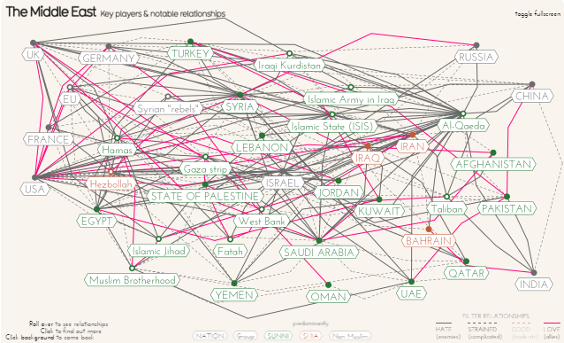
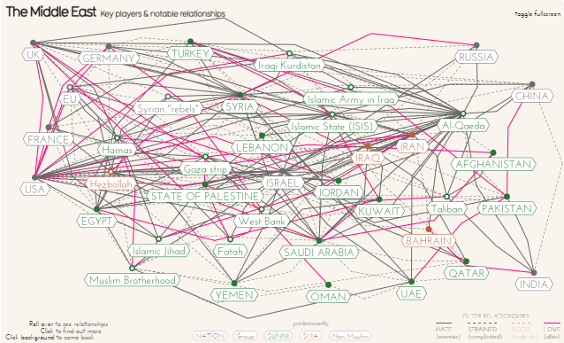
Image: This amazing tangled knot of a diagram, made by U.K. data journalist David McCandless, displays the key players and notable relationships in the Middle East. What it communicates is something no one doubts: the Middle East is a confusing place. Image Source: https://www.theguardian.com/news/datablog/ng-interactive/2014/sep/24/friends-and-enemies-in-the-middle-east-who-is-connected-to-who-interactive

Without doubt, security is the first and fundamental objective of governments involved in the building of a sustainable regional security in the Middle East but it is not the only one. On one hand, different actors are cooperating to counter the Iranian threat and the affiliated militias. On the other hand, multilateral cooperation is taking a way forward from the mere security interests, while economic and thus political aims are now being prioritized. One of the things that emerged  especially in the last 20 years, is that the US role in the region is vitally important but it works much better when it is done through multilateral efforts of allies. In an ideal World one would see the inclusion of Russia and China in this multilateral work, but if not, it is up to the countries of the region, the US, the EU and other willing actors to try to take action to address the regional challenges. Up to now military action has played an important role—through aviation, maritime and border security; but we are moving toward an increased non-military cooperation. 

In Middle Eastern minds, a unified front would play a decisive role in dealing with major fundamental challenges that are undermining the regional stability, such as Iran. Nonetheless, such unified front would not only look at allies, but would strive to include enemies too. Saudi Arabia and Iran informal talks are a clear proof of how the two want to avoid a collision that would destabilize their respective systems of power.

In this frame, the Middle Eastern geopolitical scene has been shaken in recent years by a completely unexpected, almost paradoxical, convergence such as that between Saudi Arabia and Israel. In this case, the most significant episodes were perhaps the apparently repeated meetings, between 2016 and 2018, between the influential Saudi prince Turkī al-Fayṣal, former head of the secret services, and Tzipi Livni, co-secretary of the largest Israeli opposition party, together with General Amos Yadlin and his colleague Ya'akov Amidror, formerly head of military intelligence and National Security Advisor. Since those years, an intelligence-sharing program has begun between Saudi Arabia and Israel to monitor both the pro-Iranian non-state actors in the region, from Ḥizbullah to the ḥūṯī, and the advancement of the Iranian missile program. 

In Riyadh, the hope is that Israel—through its influence on groups in Washington—will be able to coordinate robust pressure on the US political establishment to activate containment of Iran, by introducing or re-imposing sanctions, and possibly helping to reactivate Washington's commitment to defending the interests of all its traditional Middle Eastern allies. The Saudis therefore offered new demonstrations of loyalty to the United States, including a willingness to open a new chapter to secure Israel's future in the region.

Such normalization reflects nothing but the footsteps traced by Obama, Trump and Biden’s presidencies to leave responsibilities to local actors whenever US interests are not at stake. Also, it reflects a profound need for a sustainable regional security system that could develop simultaneously to the creation of ties of political and economic-financial nature and access to resources. An example is the announcement of the giant Dubai Port (Dp) World that it intends to settle in the Israeli port of Haifa or the maritime expansion strategy of the United Arab Emirates. This demonstrates a need for new funding and space to stay afloat in a crisis environment. 

In this sense, the "Abraham Agreements" go toward this direction but do not come out of nowhere, in that  they represent a tactical convergence between the interests of the actors involved. The Arab Gulf countries, including Qatar and Oman, have been cultivating economic-financial, intelligence and security relations with Israel for years, behind the scenes or in a semi-formal manner. 

In 2015, the Emirates granted the Jewish state to establish diplomatic representation at the International Renewable Energy Agency based in Abu Dhabi. Together with Egypt, Qatar has been the main mediator between Hamas and Israel for years. In 2018, Oman formally received Israeli Prime Minister Benjamin Netanyahu. In the same year, Saudi Crown Prince Mohammed bin Salman said in an interview that Israelis "have a right to have their own land" and that Saudi Arabia "has no problems with Jews". Also in 2018, Bahraini Foreign Minister Khaled ben Ahmad Al Khalifa even went so far as to take Israel's side against Iran. Commenting on the umpteenth air raid in Syria attributed to the Jewish State Air Force against alleged Iranian military bases, he stated that "Israel has the right to defend itself and eliminate sources of danger".  

If the Turkish threat is added to the Iranian one, the Jewish state could be—together with Russia—a new factor of protection. Behind the curtain of the agreements also hides Saudi Arabia. If Bahrain has signed an agreement with Israel, it is because Riyadh has given the green light. Saudi Arabia then granted the opening of its airspace to air links between Abu Dhabi and Tel Aviv. To do more, Mohammed bin Salman must wait to formally take power, so that his father - the over eighty and sick King Salman - passes away. Mohammed bin Salman’s ambition is to become the protector of all the holy places of Islam. Science fiction, at least for now. 

Is this frame a solid basis for a sustainable regional security system? It is too early to answer and in the following 20 years changes will shape a new frame. As presented in this article,  advances have been made and different actors are building a new unified front. Nonetheless, unanswered questions still remain. One of this concerns Iran and the future of the JCPOA. Should a comprise be found, and sanctions reduced, the unified front will undoubtedly accommodate the US. Nonetheless, the JCPOA works have proofed to be a failure in the past, and unexpected outcomes cannot be excluded. Moreover, the JCPOA will not be enough to tackle other issue but the nuclear one. While allies are talking to each other, and enemies are being included in such dialogue, religious and ethnic differences won’t be easily overcome through politics and economics.

November 18, 2021 — No Comments

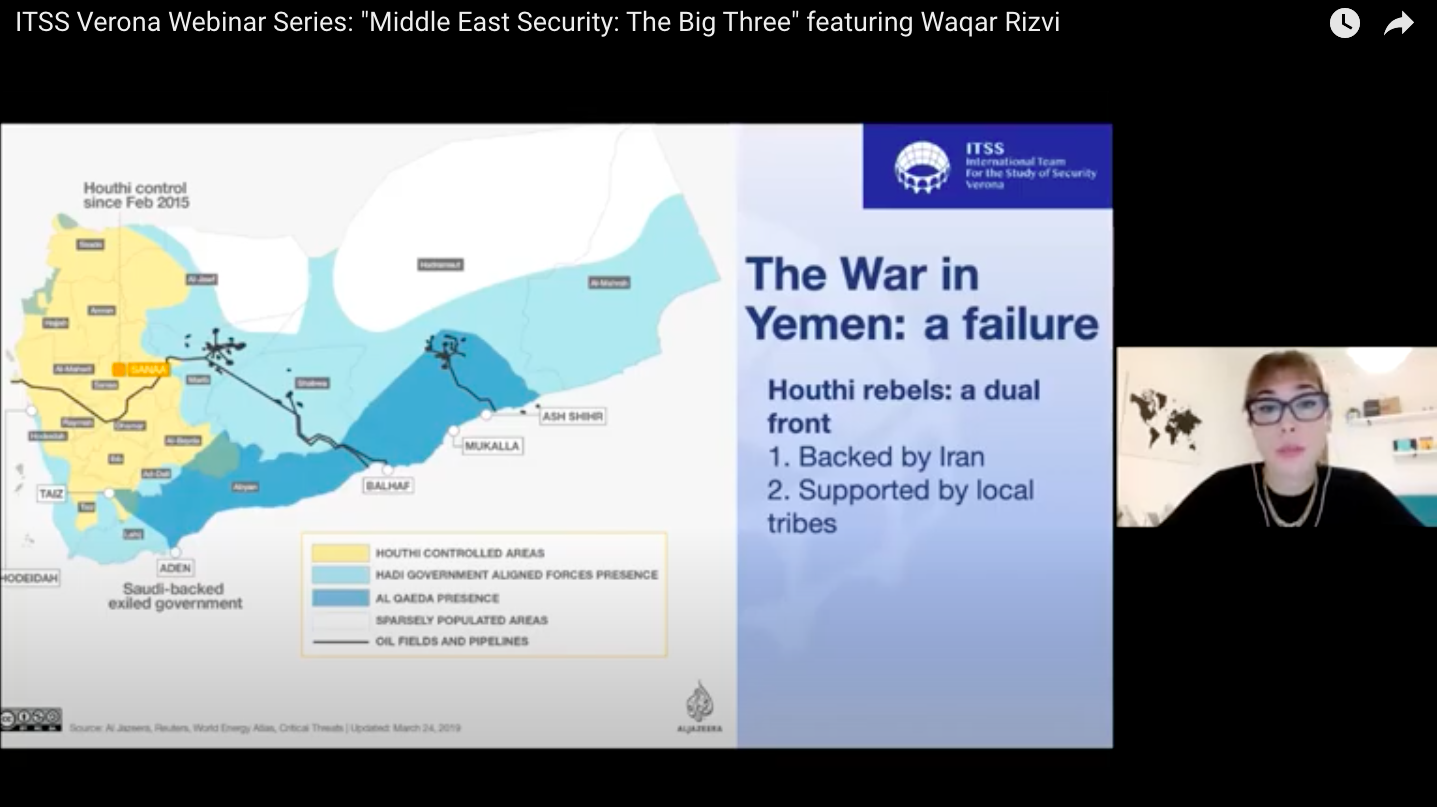
ITSS Verona 2021/22 Webinar Series: “Middle East Security: The Big Three” featuring Waqar Rizvi

For its second event of the 2021/22 Webinar Series, ITSS Verona members Martina Gambacorta, John Devine and Omri Brinner discuss Middle Eastern security with award winning journalist and political analyst Waqar Rizvi. In this truly interactive event, our chair and members explore particular dynamics pertaining to the three big players in the region, that is, Israel, Saudi Arabia and Iran.

October 1, 2021 — No Comments

Iran and the International Community: A Frame

In this interview, the Ambassador Giulio di Sant’Agata, former Italian Minister of Foreign Affairs, tackles a complex issue: the International Community's response to the Iranian threat.

Interviewer: Martina Gambacorta

May 13, 2021 — 1 Comment

ITSS Verona Interview – Freedom of expression and Worship in Iran

An interview with Dr. Ali Fathollah-Nejad on freedom of expression and worship in Iran and an interview with an Iranian convert from Islam.

Interviewing Team: John Devine, Omri Brinner, Angelo Calianno and Martina Gambacorta.

May 3, 2021 — 2 Comments

China’s Footprint in the Middle East: Strategic Partnership with Iran

By Carlotta Rinaudo et al

Iran and China sign a 25-yearlong "Comprehensive Strategic Partnership" on March 27, 2021.

Late March this year the foreign ministers of China and Iran signed the “Comprehensive Strategic Partnership” in Tehran. According to a leaked draft, this 25-yearlong agreement would allow China to invest in many Iranian sectors, from banking, telecommunications, healthcare, railways, to information technology. In return, Beijing would secure a discounted supply of Iranian oil and easy access to Iranian islands and ports. In particular, the port of Jask, which sits outside the Strait of Hormuz, would provide a strategic gain for the so-called ‘String of Pearls’, a network of Chinese naval bases that stretches from Mainland China to the Horn of Africa. Additionally, the agreement would also allow enhanced military and intelligence cooperation between the two countries.

Following the announcement of the agreement, alarm bells rang on many Western media outlets. In a hardly surprising move, analysts were quick to label the two countries as the “New Axis of Evil”. It also raised qualms among the Iranian population, which fears that the deal would be a “sellout of Iran’s resources”, with some Iranians calling the agreement as “the new treaty of Turkmenchay”. This is an expression that describes an unjust settlement, and that recalls the treaty that forced Qajar Iran to cede large parts of its territory to the Russian empire in the 19th century. 

This reaction, however, might be considered an exaggerate speculation. In fact, a more cautious viewsuggests that the deal could be more symbolic than we think. It may also resuscitate Iran from its diplomatic isolation – and give Tehran more bargaining power in renegotiating the Joint Comprehensive Plan of Action (JCPOA), commonly known as the Iran nuclear deal.

An analysis of the historical relations between the two countries can explain why prudence will be preferred over risk. China and Iran are two ancient cultures whose cooperation is rooted in time. In the 80s, Beijing and Tehran collaborated to shield themselves from the external pressure imposed by the US and the USSR, condemning external violation of sovereignty and interference from big powers. Over the past decades, the two have developed a Great Power – Middle Power Partnership, where Tehran has often been dependent on Beijing. However, it needs to be noted that China does not want to be involved in Iran’s disputes, and it is also well aware through experience that doing business with Tehran is no easy task. In 1987, Iran attacked a US tanker with a Chinese-made Silkworm anti-ship missile. To Beijing, using Chinese weapons against an American target was an irresponsible provocation. Furthermore, Iranian sanctions have also been a burden for China to bear. In January 2017, Iran tested a medium-range ballistic missile for the fifth time since the nuclear deal. In response, the United States imposed unilateral sanctions on 25 individuals and companies, among which there were two Chinese firms and three Chinese citizens. A risk-averse China would not want these past events to be repeated, which is why Beijing is carefully moving forward in its relationship with Iran. Thus, analysts should not reach quick conclusions and apply the “New Axis of Evil” label, because today’s Sino-Iranian relations are aiming for prudence and caution.

China is using these Comprehensive Strategic Partnerships as a regular instrument of foreign policy, which means that Iran is not its only partner in the region. Beijing has signed similar agreements, for example with Saudi Arabia and the UAE, both rivals of Iran and allies of the US. This is why it is also careful that its relations with Iran do not not jeopardize the balance of power in the Middle East – and, more importantly, the influence it has gained in the region. 

Like in the 80s, Iran and China continue to collaborate today to ultimately balance American regional dominance. The US under the Trump Administration decided to withdraw from the JCPOA and introduce the policy of “maximum pressure on Iran”. However, this only forced Tehran to look towards East. Trump’s decision created a vacuum – a vacuum that China was eager to fill, to emerge as the new major player in the Middle East today.